



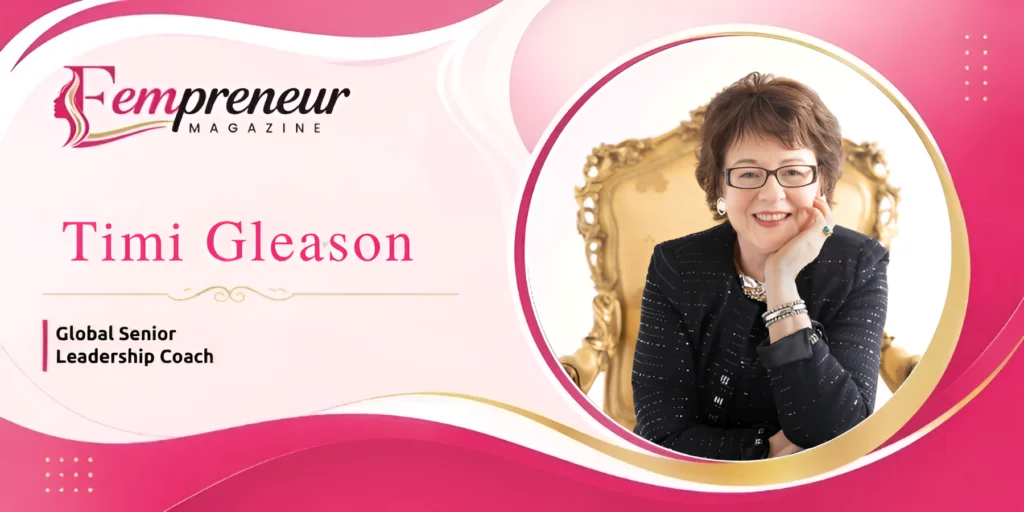
She doesn’t just coach leaders. She rewires the way they see themselves, their work, and the world they were always meant to lead.
Some people find strategy. Coach Timi Gleason became it.
Over two decades. Four industries. Hundreds of leaders transformed. One woman who refused to let the chaos of the world define the ceiling of what leadership could look like. Coach Timi Gleason, Global Senior Leadership Coach, Executive Strategy Advisor, Career Numerology pioneer, and the architect of Soulwork Maps, has spent her career doing what most coaches only talk about: helping leaders stop surviving and start becoming.
From Fortune 200 boardrooms to one-on-one executive sessions with GenX leaders navigating a world in freefall, Timi has built something rare, a philosophy of leadership that is equal parts rigorous and soulful, strategic and human, grounded in data and alive with purpose. Her frameworks don’t just produce better leaders. They produce aligned ones.
THE EVOLUTION OF A STRATEGIC LEADER
Your journey spans over two decades across bioscience, technology, marketing, and government sectors. What inspired your transition into executive coaching, and what pivotal experiences shaped your leadership philosophy?
Like so many of you, there have been many times when jobs were scarce for me. But when I worked, I experienced relative ease moving between industries. This is generally an unusual option, but I was very clear about my transferable skills. My ideal employer would say, “I think you may be the only one who can do this for us.” I had to decide if I was going to worry about being an imposter or fully embrace the potential that others saw in me. I found myself in many new situations, and asking good questions was a natural survival instinct for me. My curiosity mixed with confidence was a strength, and a reason for others to get to know me. By early 2002, I understood what a “Coach Approach” meant, and I could see that it was a natural skillset for me. A coach approach is used in executive coaching to foster self-management in others. At the Sr. Mgr to VP level, self-management and accepting accountability is critical. One of the biggest complaints I have heard from C-Suite and Sr. VP/VP levels is: “I don’t have time to babysit these leaders! They need to quit consulting with me on what to do.”
That being said, it’s a leader’s job to mentor, inspire and develop and my job to tap into their genius. I like operating between these extremes.
You work closely with C-suite and senior leaders navigating complexity and high-stakes decisions. What patterns do you consistently observe among leaders operating at this level?
There are various challenges that Senior Director and VP level leaders face as their influence becomes more nuanced and complex. The classic areas, no matter how professional and experienced the client is: Executive Presence and Mindset, Transparent Communications, Effective Conflict Resolution, and ways to Influence peers, policy and their people while building networks and business acumen. This is the most important one as is Accepting Accountability. As a rule, my clients are extremely capable, but there may be a need to refine or reboot a behavior that has, over time, lost its impact. My philosophy is that everyone’s basic model is enough. We just need to work on the bells and whistles that will boost their effectiveness.
A portion of my assignments involve addressing their team environments. This is where my background in Stakeholder Centered Coaching comes in handy. I am often asked to conduct a verbal 360, and to evaluate the criticisms and perceptions that are occurring about my client. Ideally the stakeholders are invited to participate with Feedforward (different from Feedback). Not surprisingly, certain types of personalities are targets for “not fitting in” with the good ol’ boys. Usually, they are strong analytically. They will speak up if they have a reason to and defer, if they are alright with the direction things are going. If their boss agrees that they are fine, we may reposition their behavior in meetings. We focus on body language, eye contact, and group presence. It’s fascinating how much power introverts wield in the middle of a group discussion by offering a nod of approval or a “thumbs up” blessing. It is easy to underestimate the need for engagement from more verbal colleagues.
Your work emphasizes uplifting leader perspective. What does this mean in practice, and why is it so critical in today’s leadership landscape?
In my opinion, today’s leadership landscape is brutal. It’s always been tough but with all that is going on in the world, the economy and in our homeland, business leaders are out there taking hits without much peace of mind in other areas of their lives. I work almost exclusively with GenX males currently. As a group, they are verbal, frustrated, and feeling desperate enough to threaten to burn bridges, and professionally, that’s just not acceptable. We work on reframing, thriving not just surviving, and we discuss the long view. It should not be a goal to control everything, much as it would simplify their lives. It’s a maturing process that comes with experience, and by the time they get to me, they are ready to pivot. We sort out the chaos and name the issues, then start removing barriers. It’s very do-able but working the plans takes patience and time.
The world is in the middle of a huge transition. We all need to adapt and re-choose our futures. As third dimensional beings, it’s a strategic advantage to be able to dimension jump. This isn’t as foreign as it sounds. I like introducing 4th and 5th dimension strategies. Gamers understand the fun of dimension hopping in video games. It changes how the results you pursue come to you. It’s a hopeful technique because you realize that progress is actually happening even though it’s not obvious yet. Lagging indicators can suggest the future but so can patterns. Pattern recognition is a valuable superpower. This can become an area of future mastery. And once you have a grasp on a situation, you can run with it.
Being recognized among the Top Fifty Who’s Who in the World Coaches is a remarkable milestone. What does this recognition represent in your journey?
Being invited was the best part. I felt “seen” which is something I think we all want. And later, this global group of influencers offered me a chance to get a PhD in my field. They were globally networked and have alliances focused on awarding educational credit for real world experience and innovation. Earning a PhD is no small feat, and the invitation was very tempting. I admired their elegant approach.
REDEFINING STRATEGIC LEADERSHIP
In today’s rapidly evolving world, how do you define strategic leadership in 2026, and how is it different from traditional leadership models?
Traditionally, strategy is based on a well-established military model. Strategy in the military is largely tactical. I was fortunate to study under a more nuanced approach in the late 80’s. I worked for a Fortune 200 company who required our team to provide both an Operating Plan (Fall) and a Strategic Plan (Spring) for which we held offsites at two different times of the year. Operational Planning is about metrics, actions, and results. While MOST executives regard financial goals as results, I would argue that a company’s financials are (at best) “metrics” for something bigger. Strategy is about vision, what the company is becoming or wants to aspire to. It requires creating tension between a Current State and a (future) Desired State. There are strategic metrics (market share, brand strength, market acknowledgement, innovation) and operational metrics (financials, projects finished, stages completed, hiring, training, campaigns, awards won). It takes some practice and discussion, but it’s easy to learn. Strategy is tied to your five senses. You can “taste it”. You can “see it” coming true.
Important for strategic planning is the presence of Three Core Strategies. These are the three buckets where all the action steps can go for prioritization and due dates; you can’t work on fifty projects at once. This is why we get burned out. It never stops surprising me is how misunderstood strategy is and how innocently old-fashioned most companies are in their pursuit of tactics and metrics WITHOUT milestones, core strategies and an inspiring Desired State (usually 18–36 months out).
Many leaders achieve success but still face friction, misalignment, or burnout. Why does this happen, and how can leaders evolve beyond it?
It’s a structural problem at the most basic level. Too much shooting from the hip and not enough Current State versus Desired State structure. Everyone needs to agree to prioritize and focus around Three Core Strategies. Those come from brainstorming and conversation. Inspired leaders jump out of bed in the morning and do whatever it takes to achieve their dreams. They do it “together” and the joy is contagious and fulfilling. Sure, the pressures and disappointments continue, but those are nothing but a blip on the radar of a compelling Desired State.
You specialize in pattern recognition at scale. How does this ability transform the way leaders make decisions and identify opportunities?
First, I want to clarify that while I specialize in pattern recognition at scale, I am not using computers to do this. I am working with leaders to hone their critical thinking skills by offering quick and dirty access to chaotic and complex challenges through basic, simple techniques. Every problem needs an access point. With an access point, you can “scenario build”. Too many leaders rush to action and conclusions, often working on the wrong problems. Scenario building locks in expertise, possibility, and choices. A very simple business example of scenario building is holding a company fire drill. The leaders of the fire drill team learn a lot about their plan before anything real may happen. It gives them a point of access to solutions. They perfect their plan.
A client company had a CRM and a call center that would go down periodically. They would completely panic, understandably, because it meant the services went down and the customers couldn’t reach them. The discussion we had revealed that there was no tracking of how long it takes to correct down-time incidents. They would debrief what they did wrong, but never on what they do right. And they didn’t track the time between episodes, so they didn’t have any idea whether they were improving over time from all these bad experiences. If you don’t stop to collect your real-time data, you can’t learn from it or see that you are actually moving towards better times. These are all forms of scenario building and gaining access points.
Your concept of identifying “Opportunity Portals” is intriguing. How can leaders better recognize and act on these moments of strategic advantage?
I’m one of these people who needs to “write a book in a weekend.” I lose interest if things don’t get settled pretty fast. An Opportunity Portal® is a Career Numerology concept and yes, it is very intriguing. It limits your emotional and psychological risk. It helps you budget your financial output. It gives you a reason to prioritize big goals and deadlines so you can make an exciting PUSH during a preset period of time. I like portals: you get IN and then, you get OUT. I’m impatient, and instead of being cranky, I work on supporting my vices. MANY of my clients share this trait.
Operating within a portal is less likely to lead to burn out. With a portal, you are less likely to run out of money or energy. When you set yourself up for success with clear metrics, defined milestones and an end date (not longer than a year and usually 8–9 months), “The FORCE IS WITH YOU” so to speak. Portals are perfect for busy entrepreneurs and corporate leaders.
When I wanted to create Soulwork Maps during the Pandemic, all I could see was how much time and money it might take me. Then, I realized there was a Portal of Opportunity sitting there that I could leverage. I’m into Career Numerology: it was only eight months before my next birthday. I had to decide whether I wanted to push hard for eight months. If I failed to do all the work and didn’t finish my Map creation, then at least I had controlled my losses and gained some valuable progress. Given the focus of time, I felt my success was probable: I carefully designed an effective plan of action with exciting milestones and deliverables. I met all my goals. Then I went into the next phase of the post-portal, a theme that lined up with my destiny numbers.
With the rise of AI-driven leadership, how do you see technology influencing strategic thinking, decision-making, and leadership effectiveness?
I’ve found AI to be a wonderful brainstorming partner: it draws from a global perspective — it’s visionary and full of possibility, but I also think it depends on who you are as to its usefulness and value.
Yes, I think it could replace the strategic visioning process because it has less bias, more global imagination, and limited hesitation. Would I want that? Yes and no. Human involvement and buy-in is critical to successful ventures. We don’t want to demotivate others by delegating all the thought leadership and discovery to a machine. AI is only supposed to be a resource. Humans are currently the spark for the ideas and direction of AI’s data bank. But let’s be honest, some people aren’t analytical or even reflective. So, good or bad, there’s that group that could get themselves into trouble.
There are many emerging countries who could improve with the help of AI’s input. Artificial Intelligence has access to global intelligence. At the same time, AI is very powerful and can outthink us. I can imagine lots of new problems in the future, if we fail to set clear usage boundaries and can’t agree on aligned vision for it. Our leaders need to be the guardians of sound judgment and managed execution. We’re going to have to pace ourselves without holding ourselves back. I would guess there will be some trial and error as that unfolds!
Leadership cannot be defined by one or two archetypes. Some of us are good at prompts, controlling the output, and taking our critical thinking skills with us into our AI discussions. But what if you don’t have critical thinking skills? Or aren’t ever going to be good at prompts? Or are a more kinesthetic personality, and aren’t inclined to learn or analyze? AI will mean different things to different people and their industries. This of course is why strategic planning and strategic thinking are so critical because a collective vision will compensate for these variations.
INNOVATION TOOLS & TRANSFORMATIONAL IMPACT
You are the Chief Architect of Career Numerology, a unique data-driven leadership framework. What inspired its creation, and how does it help leaders gain clarity and resilience?
Career Numerology is designed to be very learnable and only involve simple math. It operates out of the 4th dimension and as far as tools go, for me, there is little that compares to the insights, access points, and opportunities it reveals. Career Numerology is about aligning with your purpose and potential based on your own makeup. It helps us reframe challenges and stressors, even if we are leaders in businesses. It’s a type of new age business protocol.
If you are lying on the street and I’m a cop, I’m going to come up to you; ask your name; find out if you are hurt or drunk, and try to assess the situation. This protocol is standard but didn’t always exist as a procedure or tool. Career Numerology is a protocol too. It is half of a Soulwork Map which is a mapping tool after you have your Career Numerology numbers. I created the Soulwork Maps five years ago by combining numerology with two business assessments to create a life map. The life map was designed for high performers who were wondering how their work fit into their spirituality and purpose. Once you start making $250K or more and you are working a lot, you begin to wonder about “why”? I’ve created Career Numerology for everyone who is just curious about their lessons and where their life may be going. Leaders or not, Career Numerology triggers access, hope and possibility.
I found the social disorientation during the Pandemic to be alarming; and now, we have the disruption of AI and the possibility of long term unemployment as society adjusts. People need a bigger picture of their existence beyond whether they have jobs or good health. There would be nothing worse than giving up on your life because you have no purpose, then being reincarnated to do it all again: still with no purpose. We don’t need to be so stuck. Even during unemployment or being stuck in a sick bed, you can hold on to your purpose IF you know what it is. As long as you are interacting with other people, you can work your Career Numerology themes.
Your work integrates Systems Thinking, Clifton Strengths, brand archetyping, and Stakeholder-Centered Coaching. How do these methodologies come together to create measurable impact for your clients?
For 5 years, I was working on a coaching contract that gave me access to hundreds of leaders per year. Having up to 60 clients a month at times, it was a grind. The upside of that was that the monotony eventually got to me in a good way. In an effort to keep it interesting, my ingenuity kicked in. I started to see how to apply the patterns I already understood to the new situation I was in. For instance, one of my favorite tools is strategic planning.
Gradually, I saw how to create the path between Current State and a Desired State for individuals instead of for whole companies. I had already done that for departments when their companies didn’t have strategic plans. I realized that a person can create for themselves what is missing at work. Why not do that for their lives too?
Since your birthday points you in the direction of the themes you need to master, and your name offers a glimpse into the future of legacy, that creates a gap between Current State and Desired State that I had not considered. Your Core Strategies may be Education; Brand; and Health. Your timeline can be divided out in 3–5 year updateable strategies. This became a goal to create tools for this. After all, how often do you actually get to meet a truly “aligned” person? They are rare.
You often speak about strengthening leadership brand, EQ, and intentionality. How can leaders consciously refine these elements to elevate their influence?
We explore this through the assessments and data we collect together, as coach and client. Until you experience the resonance of Career Numerology it’s difficult to explain. Some people say that “it all makes sense.” Or they may say, “those are the words I have been missing.” We put what is happening into words. We name the themes. We discuss a Desired State to compare against Current State. Together we create the plan to bridge the gaps, define the metrics, and celebrate the milestones as we compare notes about what is changing. It’s an ongoing conversation that triggers personal and professional mastery. Wildest dreams can come true. Joy is present. There are amazing stories at the end of the day. Leadership EQ is based on self awareness and self-management. You are getting your needs met while you are immersed in living a meaningful life. People experience your centered and confident presence and want to know you. I have clients who are told, “I want what YOU HAVE. Tell me what you’ve done.”
VISION LEGACY & THE FUTURE OF LEADERSHIP
As organizations face increasing complexity and constant disruption, what shifts do you believe are essential for the next generation of leaders to succeed?
On the premise that successful navigation of life assumes that you are learning how to navigate the inevitable disruptions and complexities, a Current State and Desired State will lighten the load. Why not move away from the drama of a “Who Done It” mystery to the joyful potential of a baseball game? Why not hit the challenges “out of the park” on a daily basis?
In that scenario of having a current state and desired state, good luck and windfalls are just as likely to occur as setbacks, so why not choose them instead? The complaint, “We don’t have time for that!” translates in my mind to “we don’t know how.” If you have ever done visioning, you know that once you have the details locked down, you are already half way there. Learning how to gain time and momentum by being prepared and receptive is game changing.
I’ve been in several situations where the Desired State was clear, practiced and passionately desired. In both cases, their goals included “complete culture shifts with new behaviors” over 12–18 months. I have two examples of dimension shifting, both goose bump-moments for me. A marketing department of 14, after putting in hard work and passion into crafting their Desired State, found themselves completely undermined by their corporate offices within a week. In a first, their HQ swooped in and took over their operations for a year. They were told what to do, and how to do it. It was disappointing and demoralizing until we debriefed 15 months later.
The debrief, however, revealed something no one had considered or noticed since the takeover. Even though the corporate offices took them off in a different direction than they had planned, the behavioral transformation, the networks and relationships, and the long term metrics had occurred anyway. Every professional goal they had envisioned had been met or exceeded, despite the power grab. They had done it, and to realize that transformation was a group-gob-smack moment.
A field operations department forgot to check their milestones and check in with their Desired State after 12 months. They were on a 24-month plan, and so busy doing everything. When we humbly sat down to “see where we are at” at 26 months, it was very unsettling. The department was unrecognizable. It was well beyond anything that had originally been imagined. The Desired State now sounded too small. The department head turned to me in disbelief. He said, “Oh my goodness, WHEN did this happen?! We are far beyond any of the original plan.” It was that dimension shifting phenomenon. It shakes you.
In the future, leaders need to look outside of traditional business models. We’re pioneering again. We can afford to be more wholistic. We need to take risks.
As a visionary redefining strategic leadership, what legacy do you hope to leave behind for future leaders navigating influence, impact, and purpose?
We need new business models with new tools and tricks. The old ways don’t land any more. We know more about the human mind than ever before. We can tap into more. I have created Soulwork Maps and Career Numerology for leaders who want to crack the code on their purpose and the bigger picture of their work. The roles we take in life are the stages we perform on. Our inner work helps to define the experiences we have in those situations. Generally, we ignore the fact that good planning saves time.
I am offering a bridge between now and then. We can reduce our own stress by changing our perception of work and ourselves. This idea that we need to cope with living in a dog-eat-dog world sounds very 1950’s to me. Over 60 years ago, we had less options. I want people to realize the blessing and the genius that they are to others and to see the solace they offer in the face of so much daily adversity. We are not victims. How many people do you know that don’t see what they do as “contributing”? To them, it’s just “work.” For most people, this mindset is self-deception. We are accountable. We can be in choice.
The world is changing around us. It’s not going to stop. What do you want your legacy to be? The meaning-making that I offer is that you have a choice. You can have the opportunity to transform the lives of ALL those around you. I’m suggesting a focus on life mastery. We each have the choice to pass along our joy to clients, customers, stakeholders, and vendors. And because it is not a dogma but simply an access protocol you are free to pursue your dreams, on your terms.